
Relevance in numismatics is rarely accidental.
Market potential for five-cent coins produced in 1977 nickel depends entirely on metal surface preservation.
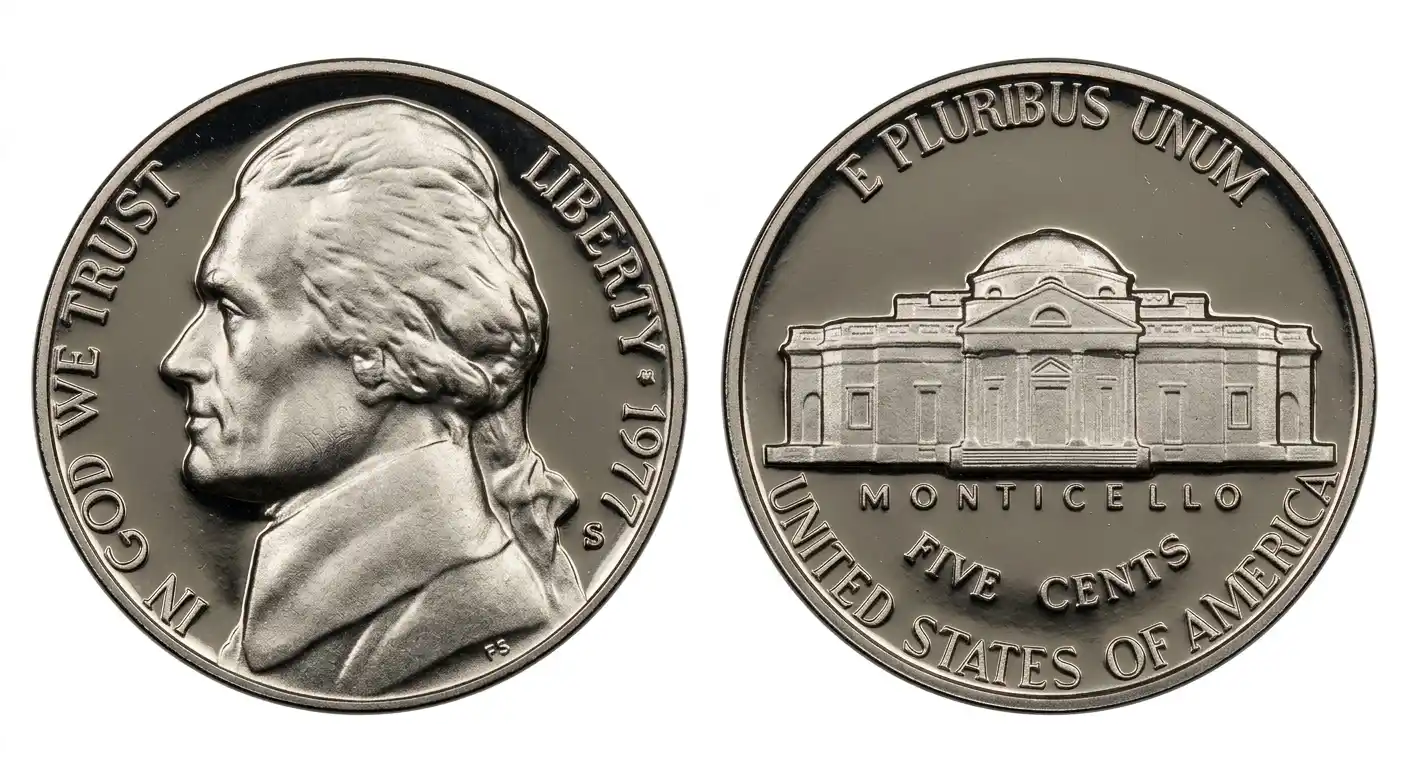
Mass production during this period created a surplus of circulating examples.
Investment appeal remains exclusive to units avoiding mechanical contact.
| Parameter | Value |
| Composition | 75% Copper, 25% Nickel |
| Mass | 5 grams |
| Diameter | 21.21 mm |
| Edge Type | Plain |
| Designer | Felix Schlag |
Mintage Distribution Across Facilities
Total production volume exceeded nine hundred million units.
High availability causes low valuation for common specimens.
Coins lacking a mint mark originated in Philadelphia.
Letter D signifies striking in Denver.
Letter S appearing on mirrored coins indicates San Francisco.
- Philadelphia — 585,376,000 units
- Denver — 321,548,116 units
- San Francisco — 3,251,152 units
Impact of Grading on Market Pricing
Sheldon scale ranging from 1 to 70 points determines strike quality.
MS66 condition represents a critical threshold for the 1977 issue.
Specimens falling below this level carry nominal value.
Reaching MS67 status triggers exponential price growth.
Scarcity of perfect preservation amidst seventies mass technology explains this trend.
| Condition (MS) | 2026 Estimated Price | 5-Year Change |
| MS63 | $0.25 | 0% |
| MS64 | $1.00 | +5% |
| MS65 | $5.00 | +12% |
| MS66 | $25.00 | +18% |
| MS67 | $450.00 | +35% |
Technical Factor of Full Steps
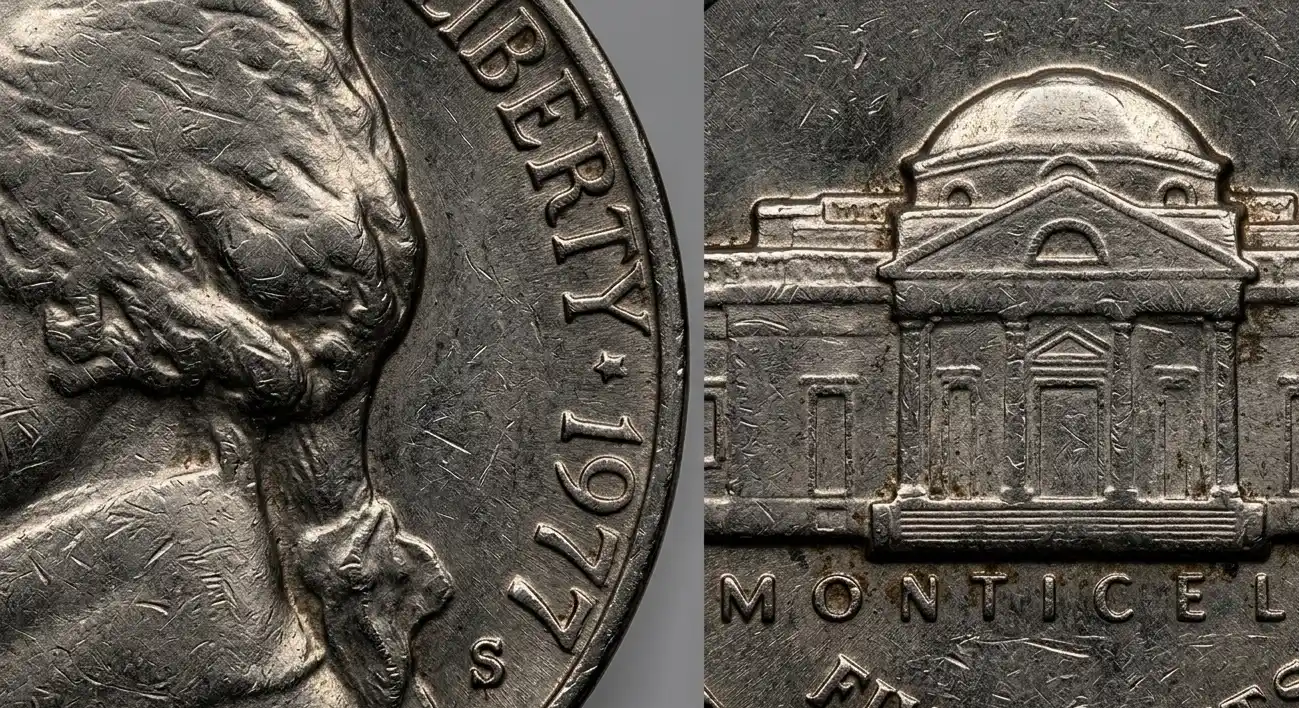
Graders prioritize steps located on the reverse at the Monticello building.
Clear separation of five or six steps grants the Full Steps designation.
This detail indicates a strong die strike.
Absence of Full Steps reduces value tenfold even with high numerical grades.
Presence of FS → confirmation of strike quality → automatic demand increase.
| Grade | Without FS Designation | With FS Designation |
| MS65 | $4 | $15 |
| MS66 | $18 | $80 |
| MS67 | $150 | $2,500 |
Significant Auction Records
Analyzing data from professional certification services reveals peak values.
Heritage Auctions sold a 1977-D specimen graded MS67+ FS for $5,170.
Lack of contact marks typical of bag storage justified the high price.
Philadelphia specimens in similar condition appear less frequently, reaching the $4,000 mark.
Proof coin markets demonstrate stable but lower indicators.
1977-S coins in PR70 Deep Cameo condition trade between $150 and $200.
Mint Errors and Market Share
Production mistakes create unique objects standing outside standard catalogs.
Highest value belongs to coins struck on planchets intended for other denominations.
Image displacement exceeding 25% also increases valuation.
- Double Strike — image doubling resulting from repeated die contact with the planchet.
- Striking on cent planchet — coin gaining a copper color and smaller diameter.
- Die Clash — obverse elements showing through on the reverse.
Valuations for such errors range from $50 to $1,500.
Inflation and Demand Factors
Statistics show annual price increases for rare positions at 4-7 percent.
Common coins lose value due to dollar inflation.
Investing remains justified only when purchasing coins with PCGS or NGC certificates.
Uncertified coins often possess hidden defects discovered during professional inspection.
Cleaning a coin with chemicals completely destroys its collective value.
Stripped patina → loss of mint luster → receiving Details status instead of a numeric grade.
Authentication and Defect Identification
Verification proceeds through three primary directions.
| Verification Object | Sign of Authenticity | Sign of Alteration |
| Weight | Exactly 5 grams | Deviation exceeding 0.2 grams |
| Fonts | Sharp letter edges | Blurriness or metal swelling |
| Surface | Radial flow lines | Cyclic scratches from cleaning |
Relative Scarcity Compared to Neighboring Years
1977 production counts as more massive than 1971 or 1975 issues.
However, a surge in “weak strike” steps occurs specifically in 1977.
This makes discovered Full Steps specimens more valuable relative to similar positions of other years.
Market dynamics over the last three years show rising interest in MS66+ grades.
Registered coin counts at this level in NGC registries do not exceed several hundred.
Market Valuation Algorithm
Establishing an exact price requires using the elimination method.
Process beginning — checking the mint mark.
Weighing excludes counterfeits or use of incorrect planchets.
Visual analysis focuses on Monticello steps.
Comparing results with auction records yields a base figure.
Appraisal remains subjective until fixing the grade in a slab.
Purchasing 1977 coins lacking Full Steps rarely yields profit.
Prioritizing surface quality remains the main task for a numismatist.
Metal condition dictates the final check amount.
Absence of wear guarantees capital preservation.
Historical significance of 1977 is minimal, value being contained in physical perfection of a specific item.
Long-term Storage Methods
Using PVC-free holders and regular a coin finder app checking prevents chemical corrosion.
Stable indoor humidity stops copper and nickel oxidation.
Excluding direct skin contact prevents fingerprint formation.
Oxidized metal → grade loss → market value reduction by 60%.
Professional storage ensures asset liquidity in the future.
Identification of Production Deviations
Small die cracks often get mistaken for price-increasing defects.
In reality, such features rarely impact final cost.
Distinguishing a bag mark from a production error is vital.
Bag mark — consequence of coins colliding during transport.
Mint error — result of equipment failure at the moment of impact.
Error value exceeds damaged coin value.
Mintage Survival Statistics
According to PCGS and free coin app reports, less than 0.1% of the mintage survived in conditions above MS65.
Main coin masses lost collective appearance during initial circulation years.
Searching for perfect specimens in modern bank rolls is impractical.
Probability of finding MS67 in circulation approaches zero.
Market relies on old collections formed decades ago.
New high-grade coin arrivals happen extremely rarely.
This creates a steady price floor for rare positions.
Comparing Investment Appeal of Philadelphia and Denver
Philadelphia leads in total production volume.
Denver demonstrates higher frequency of Full Steps occurrence.
Paradox lies in higher prices for rare Philadelphia specimens.
Fewer surviving perfect Philadelphia coins create a deficit.
Supply deficit → rising auction bids → fixing new records.
Denver is characterized by greater price stability.
Choice between facilities depends on investor strategy.
Aggressive growth characterizes Philadelphia.
Conservative stability belongs to Denver.